Relevance Theory and Muqtadha al-Hal: Toward a Pragmatic Balaghah Framework for Arabic Discourse Analysis
DOI:
https://doi.org/10.60040/jak.v5i1.141Keywords:
Arabic Balaghah, Arabic Discourse Analysis, Muqtadha al-Hal, Pragmatic Balaghah, Relevance TheoryAbstract
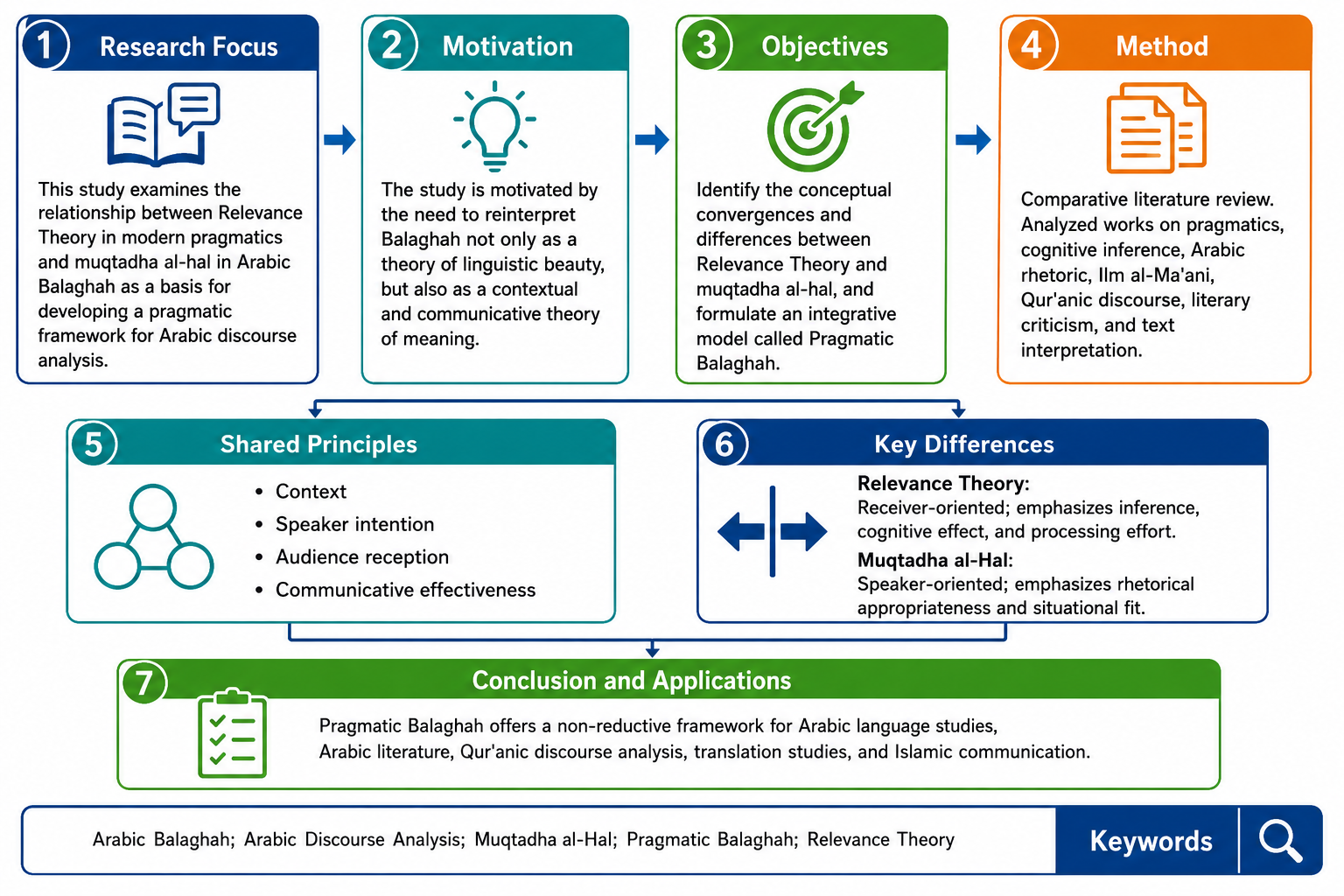
This study discusses the relationship between Relevance Theory in modern pragmatics and muqtadha al-hal in Arabic Balaghah as a basis for developing a pragmatic framework for Arabic discourse analysis. The discussion is motivated by the need to reinterpret Balaghah not only as a theory of linguistic beauty, but also as a contextual and communicative theory of meaning. This study aims to identify the conceptual convergences and differences between Relevance Theory and muqtadha al-hal and to formulate an integrative model called pragmatic Balaghah. Using a comparative literature review, the study analyzes scholarly works on pragmatics, cognitive inference, Arabic rhetoric, Ilm al-Ma‘ani, Qur’anic discourse, literary criticism, and text interpretation. The findings show that both frameworks emphasize context, speaker intention, audience reception, and communicative effectiveness. However, Relevance Theory is more receiver-oriented, focusing on inference, cognitive effect, and processing effort, whereas muqtadha al-hal is more speaker-oriented, focusing on rhetorical appropriateness and situational fit. The study concludes that pragmatic Balaghah offers a non-reductive framework for Arabic language studies, Arabic literature, Qur’anic discourse analysis, translation studies, and Islamic communication.
References
Abas, Ummu-Hani, Azlan S. Baharum, Abdul M. Ismail, Mohammad N. Jaffar, Ahmad A. M. Ali, and Rasmina Hasbullah. 2023. “Analisis Keperluan Pembinaan Rekabentuk Model Bahasa Arab Untuk Perundangan Islam Melalui Integrasi Ilmu Naqli Dan Aqli.” مجلة إدارة و بحوث الفتاوى 28(2):154–74. doi:10.33102/jfatwa.vol28no2.509.
Aflisia, Noza, Hendrianto, and Kasmantoni. 2022. “Teaching Balaghah for the Purpose of Appreciation of Al-Quran Language.” Lughawiyyat Jurnal Pendidikan Bahasa Dan Sastra Arab 4(2):156–72. doi:10.38073/lughawiyyat.v4i2.537.
Arib, Juhrah M., and Sabil Mokodenseho. 2023. “The Taḥlīlī Method in the Interpretation of the Qur’ān.” Mushaf Journal Jurnal Ilmu Al Quran Dan Hadis 3(1):167–82. doi:10.54443/mushaf.v3i1.128.
Asakavičiūtė, Vaida, and Vytis Valatka. 2020. “Martin Buber’s Dialogical Communication: Life as an Existential Dialogue.” Filosofija Sociologija 31(1). doi:10.6001/fil-soc.v31i1.4178.
Atabik, Ahmad. 2021. “Al-Naẓm Stylistic Discourse in I’jāz Al-Qur’ān Based on Al-Jurjānī’s Perspective: Analysis of Arabic Literature Criticism on the Qur’an Studies.” Ulumuna 25(1):57–83. doi:10.20414/ujis.v25i1.425.
Cahyo, Agus T. 2023. “Uslûb Dalâlî (Semantic Style) Qur’anic Verses and Their Absorption in Nature Sentence Patterns for Learning.” Qalamuna Jurnal Pendidikan Sosial Dan Agama 15(1):417–30. doi:10.37680/qalamuna.v15i1.2958.
Dalle, Muhammad, Muhammad Jundi, M. A. Hamid, and Umi Machmudah. 2024. “Innovative Thinking Approach in Designing Teaching Materials for Ilm Badi Course: A Comprehensive Framework for Enhancing Students’ Writing Skills.” Al-Ta Rib Jurnal Ilmiah Program Studi Pendidikan Bahasa Arab Iain Palangka Raya 12(1):33–56. doi:10.23971/altarib.v12i1.7944.
Darwish, Aly R. A., Mohamed F. M. Abdelgelil, Mohd A. M. Razali, Ahmad F. Hassan, and Mohd S. Abdullah. 2021. “Linguistic Miracles in the Noble Qur’An.” International Journal of Academic Research in Business and Social Sciences 11(9). doi:10.6007/ijarbss/v11-i9/11137.
Dozan, Wely. 2021. “TELAAH ASBĀB AL-KHATĀ’ FI AL-TAFSĪR (Sebab-Sebab Kesalahan Dalam Tafsir).” El- Umdah 4(1):19–43. doi:10.20414/el-umdah.v4i1.2549.
Fatihunnada, Fatihunnada, Nailil Huda, and Hannanah M. Thabrani. 2022. “The Significance of Linguistic Approach in Sharḥ Ḥadīth of Miṣbāḥ Al-Ẓalām by Muhajirin Amsar.” Ilmu Ushuluddin 9(1):49–78. doi:10.15408/iu.v9i1.17966.
Gao, Fan. 2024. “Semantic Choice in Translation From Morris’ Modern Semiotic Theory.” Technium Social Sciences Journal 55:387–93. doi:10.47577/tssj.v55i1.10694.
García-Carrión, Rocío, Garazi L. d. Aguileta, María P. Cuxart, and Mimar Ramis‐Salas. 2020. “Implications for Social Impact of Dialogic Teaching and Learning.” Frontiers in Psychology 11. doi:10.3389/fpsyg.2020.00140.
Gusmian, Islah, and Mustaffa Abdullah. 2023. “The Qur’an: Its Orality and Interpretation.” Indonesian Journal of Islamic Literature and Muslim Society 7(2). doi:10.22515/islimus.v7i1.5748.
Handbücher Zur Sprach- Und Kommunikationswissenschaft / Handbooks of Linguistics and Communication Science [HSK] 46/1. 2022. doi:10.1515/9783110347524.
Hasanah, Umdatul. 2021. “Rhetoric in Islamic Tradition: Paradigm and Its Development.” Komunika Jurnal Dakwah Dan Komunikasi 15(2):241–52. doi:10.24090/komunika.v15i2.4570.
Hasibuan, Renni, Mamluatul Hasanah, and Faisol Faisol. 2024. “Improving Balaghah Mastery Through Teams Games Tournaments With Crossword Puzzle Media in Higher Education.” Al-Lisan 9(1):33–50. doi:10.30603/al.v9i1.4520.
Huda, Rizki F., and Cahya Buana. 2022. “Sufistic Language Style in Al-Qushayri’s Nahw Al-Qulub.” Lingua Jurnal Ilmu Bahasa Dan Sastra 16(2):237–48. doi:10.18860/ling.v16i2.11817.
Imam, Jahira S. N., and Komarudin Soleh. 2023. “Stylistic Analysis on the Story of the Qur’An.” Journal of Ulumul Qur an and Tafsir Studies 2(1):31–50. doi:10.54801/juquts.v2i1.176.
Irsyady, Kamran A., Saifudin Z. Qudsy, Mufliha Wijayati, and Muasssomah Muasssomah. 2023. “The Authorship of Shaykh Nawawi Al-Bantani in Arabic Linguistics Studies.” Journal of Indonesian Islam 17(2):259. doi:10.15642/jiis.2023.17.2.259-282.
Kovalenko, Hanna. 2023. “The Significance of Legal Pragmatism and Economic Analysis of the Law for the Theory of Adjudication in the Conditions of Social Life.” The Bulletin of Yaroslav Mudryi National Law University Series Philosophy Philosophies of Law Political Science Sociology 1(56). doi:10.21564/2663-5704.56.274317.
Latifah, Umi. 2022. “The Inhibitory Factor of Santri Participate Learning Kitab With Sorogan Method During Pandemic Until Post-Pandemic.” Santri Journal of Pesantren and Fiqh Sosial 3(1):31–50. doi:10.35878/santri.v3i1.332.
Mashhadi, Ali, Mohammad A. K. Far, and Seyed M. H. Mirzadeh. 2021. “Towards a Communicative Model of Language of International Law: From Linguistic Sign to Cognitive Complements.” Law and World 7(3):29–44. doi:10.36475/7.3.3.
Masitoh, Siti, Zakiyah Arifa, Nur I. Ifawati, and Diana N. Sholihah. 2023. “Language Learning Strategies and the Importance of Cultural Awareness in Indonesian Second Language Learners.” Journal of Language Teaching and Research 14(2):436–45. doi:10.17507/jltr.1402.20.
Miftahuddin, Miftahuddin. 2020. “Declaring Tafseer for Humanity: Tafseer Methodology of Hassan Hanafi.” Millati Journal of Islamic Studies and Humanities 5(1):1–15. doi:10.18326/mlt.v5i1.1-15.
Milah, Aang S., Mohamad Rohman, and Ahmad N. Rasikhullah. 2023. “Internalization of Arabic Syntactic in the Interpretation of Legal Verses.” Ijas Indonesian Journal of Arabic Studies 5(2):159. doi:10.24235/ijas.v5i2.14840.
Mitchell, Paul. 2021. “Frankenstein’s Creature on Film in the Twenty-First Century: Posthuman Monster, Saviour, and Victim Narratives.” Interdisciplinary Literary Studies 23(1):1–23. doi:10.5325/intelitestud.23.1.0001.
Mkumbata, Geoffrey C., and Dynesius Nyangau. 2022. “The Relevance of Martin Buber’s Theory of Dialogue in Contemporary Religious Organization Leadership in Tanzania.” East African Journal of Traditions Culture and Religion 5(1):69–79. doi:10.37284/eajtcr.5.1.789.
Muminov, S., and Z. Kenjaeva. 2023. “The Role of Discourse in Modern Linguistics.” Sjfsu 29(4). doi:10.56292/sjfsu/vol29_iss4/a54.
Musyafa’ah, Nurul. 2021. “Assignment-Based Balaghah Learning Module Application to Increase Literary Appreciation.” Journal of Social Science 2(6):816–26. doi:10.46799/jss.v2i6.250.
M.Z.A., Ahmad F., Wan A. W. Ahmad, and Yuslina Mohamed. 2022. “Pendekatan Peneguhan (Al-Targhib) Dalam Pendidikan Kanak-Kanak: Tinjauan Dari Perspektif Psikologi Islam Dan Retorik Al-Quran.” Al-Azkiyaa - Jurnal Antarabangsa Bahasa Dan Pendidikan 1(2):123–35. doi:10.33102/alazkiyaa.v1i2.32.
Naser, Hayder S., and Ali B. M. Al-Rikaby. 2020. “The Persuasive Power of Religious Metaphor in Selected Qur’anic and Biblical Verses.” Al-Adab Journal (135):11–32. doi:10.31973/aj.v2i135.816.
Nashoiha, Isyroqotun. 2023. “Memahami Bahasa Al-Qur`an Berbasis Gramatikal.” Ushuly Jurnal Ilmu Ushuluddin 2(1):1–26. doi:10.52431/ushuly.v2i1.1236.
Nawaya, Fehmieh R., Ahmad S. Burhan, and Abdulaziz E. Hajji. 2023. “The Effect of the Holy Qurʾan on Arabic Rhetoric: Illumination at the Path and the Fate.” Ijaz Arabi Journal of Arabic Learning 6(2). doi:10.18860/ijazarabi.v6i2.21109.
Nazar, M. 2022. “The Contribution of Metaphor to Islamic Education Learning.” Itqan Jurnal Ilmu-Ilmu Kependidikan 13(1):89–102. doi:10.47766/itqan.v13i1.286.
Niu, Min, and Thawascha Dechsubha. 2022. “The Development of Pragmatics in Morris’s Behavioral Semiotics: Semiotic Perspective.” Education Quarterly Reviews 5(2). doi:10.31014/aior.1993.05.02.482.
Nong, Yuan. 2023. “Application of Modern Philosophical Ideas to Information Theory Courses.” International Journal of Education and Humanities 10(1):256–60. doi:10.54097/ijeh.v10i1.11166.
Nuha, Muhammad A. U., and Nurul Musyafaah. 2023. “The Alignment of the Final Letters in the Alala Book by Sheikh Al-Zarnuji.” Al-Irfan Journal of Arabic Literature and Islamic Studies 6(1):83–102. doi:10.58223/alirfan.v6i1.6442.
Nussbaum, E. M., Ian J. Dove, and LeAnn G. Putney. 2023. “Bridging Dialogic Pedagogy and Argumentation Theory Through Critical Questions.” Dialogic Pedagogy a Journal for Studies of Dialogic Education 11(3):A7–25. doi:10.5195/dpj.2023.548.
Qutbuddin, Tahera. 2024a. “Introduction.” 1–27. doi:10.1163/9789004682603_002.
Qutbuddin, Tahera. 2024b. “Is Oration Literature?” Journal of Arabic Literature 55(2–3):213–37. doi:10.1163/1570064x-12341516.
Rizqi, Husain M. 2023. “Exploring Sibghah Meaning Difference: A Semantic Study Towards the Al-Baqarah Verse 138.” Journal of Language Intelligence and Culture 5(2):94–104. doi:10.35719/jlic.v5i2.119.
Rojak, Rizki A., and Irfan Addriadi. 2022. “Gaya Bahasa Figuratif Dalam Dȋwȃn Tarjumȃn Al Asywȃq Karya Ibnu Arabi.” Hijai - Journal on Arabic Language and Literature 5(2):113–26. doi:10.15575/hijai.v5i2.18364.
Rosalinda, Rosalinda, Nurdin Nurdin, and Imam Sujoko. 2022. “The Concept of Ta’ātuf as a Moderate Hermeneutic of Muṣṭafā Nāsīf.” doi:10.4108/eai.20-10-2021.2316331.
Sapil, Muhammad. 2022. “Stilistika Dan Al-Qur’an: Fenomena Budaya Uslûbiyah Bangsa Arab.” Ulumul Qur an Jurnal Kajian Ilmu Al-Qur an Dan Tafsir 2(2):188–208. doi:10.58404/uq.v2i2.109.
Siti Hafizah Aiyshah Mohd Ali, and Taj R. M. Romli. 2021. “Al-Isti‘Arah in the Novel Al-Zikrayat by ‘Ali Al – Tantawi Based on Relevant Theory.” International Journal of Academic Research in Business and Social Sciences 11(8). doi:10.6007/ijarbss/v11-i8/10735.
Sopian, Anuar, and Ijlal B. Saja. 2022. “Mastery and Problems of the Study of Balaghah: An Initial Review.” International Journal of Academic Research in Business and Social Sciences 12(8). doi:10.6007/ijarbss/v12-i8/14715.
Syafaah, Darisy. 2022. “Tahli>l Al-Amr Wa Ma’a>ni>hi Fl Al-Qur’an Surat Al-Muddassir (Dira>sah Tahli>liyah Fi ‘Ilmi Al-Ma’A>ni).” Al-Tadris Jurnal Pendidikan Bahasa Arab 10(2):354–73. doi:10.21274/tadris.2022.10.2.354-373.
Syarif, Maria U., Amrah Amrah, and Darmawati Darmawati. 2023. “Sejarah Ilmu Balagah, Tokoh Dan Objek Kajiannya.” Al-Waraqah Jurnal Pendidikan Bahasa Arab 4(1):13–32. doi:10.30863/awrq.v4i1.4860.
Thoha, Mohammad M., and Abd Hannan. 2022. “Modernization of Education Governance Based on Accelerative Paradigm Among Pesantren Communities in Madura, Indonesia.” Ulumuna 26(2):417–46. doi:10.20414/ujis.v26i2.515.
Uswatusolihah, Uus. 2018. “Pembelajaran Public Speaking Di Pondok Pesantren Untuk Moderasi Indonesia.” Komunika Jurnal Dakwah Dan Komunikasi 11(2):282–99. doi:10.24090/komunika.v11i2.1370.
Walton, Douglas, Fabrizio Macagno, and Giovanni Sartor. 2020. “Statutory Interpretation.” doi:10.1017/9781108554572.
Whetsell, Travis A. 2023a. “What Is The Public ? A Pragmatic Analysis of a Core Concept in Public Administration.” Perspectives on Public Management and Governance 7(1–2):27–36. doi:10.1093/ppmgov/gvad011.
Whetsell, Travis A. 2023b. “What Is the Public? A Pragmatic Analysis of a Core Concept in Public Administration.” doi:10.31235/osf.io/8ukmr.
Yaakob, Nor A., Syed N. S. Abdullah, Kasyfullah A. Kadir, Audrey G. Boudville, and Badrul H. M. Yasin. 2020. “Explicitation Strategy in the Translation of ‘Rihlah Ibn Battutah’ Into English.” International Journal of Academic Research in Business and Social Sciences 10(10). doi:10.6007/ijarbss/v10-i10/7781.
Yasin, Hadi. 2020. “Sisi Balaghah Dalam Tafsir Al-Baidhawy.” Tahdzib Al-Akhlaq Jurnal Pendidikan Islam 3(2):41–61. doi:10.34005/tahdzib.v3i2.894.
Yuningsih, Yeni R., Irfan Abubakar, and Farhan M. Rahman. 2023. “Pesantren and the Kitab Kuning: Pesantren Dynamics and Its Influence on the Kitab Kuning Traditions in Sukabumi.” Buletin Al-Turas 29(2):199–212. doi:10.15408/bat.v29i2.30897.
Zou, Leilei, and Zhu Yiye. 2022. “Review of Research on Development of Speech Act Theory and Its Application.” International Journal of Linguistics Literature & Translation 5(12):127–35. doi:10.32996/ijllt.2022.5.12.16.
Downloads
Published
How to Cite
Issue
Section
License
Copyright (c) 2026 Berti Arsyad, Chaterina P. Doni

This work is licensed under a Creative Commons Attribution-ShareAlike 4.0 International License.