Integrating Text-Based Arabic Instruction and Active Learning: Teachers’ and Students’ Perspectives at Darullughah Wadda’wah Islamic Boarding School
DOI:
https://doi.org/10.60040/jak.v5i2.208Keywords:
Arabic language teaching, Arabic textbooks, active learning, pesantren, hybrid pedagogyAbstract
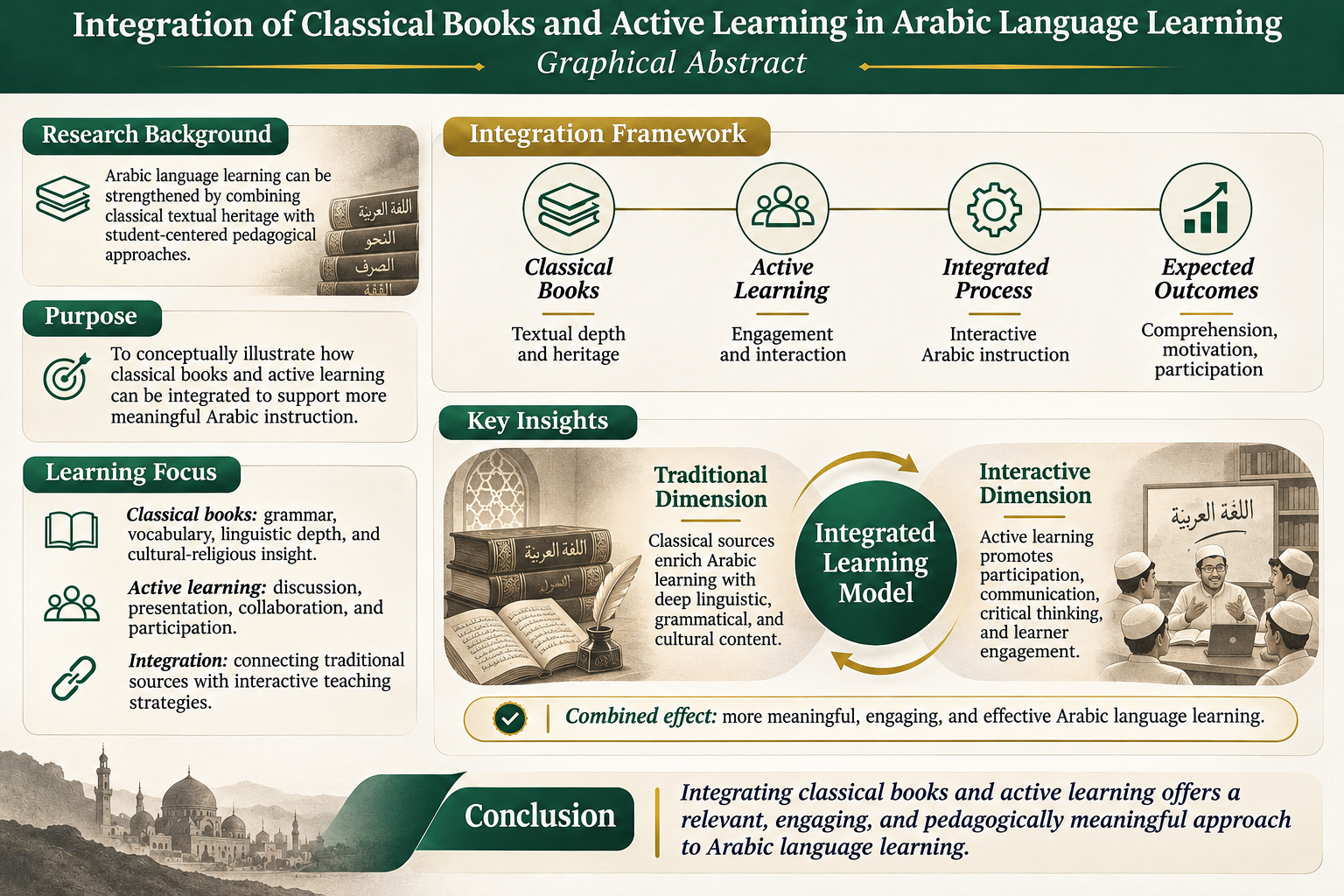
Background: Arabic language teaching in pesantren commonly combines close reading of teaching materials with teacher explanations of vocabulary and grammar. Although active learning may provide opportunities for dialogue, its integration with text-based instruction remains uneven and requires attention to learners’ experiences and classroom constraints. Purpose: This study examines how active learning is integrated into textbook-based Arabic instruction and how teachers and students perceive its implementation at Darullughah Wadda’wah Islamic Boarding School. Method: A qualitative case study focused on first-year tsanawī classes A and B, comprising 60 students in a twice-weekly intensive programme. Data were drawn from 12 classroom observations, interviews with 12 students and three teachers (two instructors and one peer assessor), and examination of Al-‘Arabiyyah li al-Nāshi’īn, Volume 4, particularly the ‘Īd al-Aḍḥā lesson. The accounts were examined through interpretive thematic analysis. Results: First, vocabulary and grammar explanations remained teacher-led, while group discussion and presentations were introduced selectively. Second, some students valued opportunities to explain vocabulary to peers, but others remained silent or needed teacher assistance, indicating unequal participation. Third, teachers identified limited instructional time, curricular demands, and differences in students’ language proficiency as obstacles to sustained active learning. Conclusion: The case illustrates a context-specific, teacher-guided hybrid pedagogy in which participatory activities supplement textbook instruction rather than replace it. The evidence concerns classroom processes and reported experiences; it does not demonstrate measured gains in Arabic proficiency.
References
Aisah, Nur Ilfi, and Ridwan Furqoni. ‘Constructivist and Traditional Approaches in Arabic Language Learning for Beginners’. Innovative Journal of Educational Research and Insights, 1 October 2024, 63–75.
Almelhes, Sultan. ‘Reframing Learner Autonomy in Arabic Language Education for Non-Native Speakers: A Theoretical Framework of Power, Control, and Motivation’. Frontiers in Education 10 (October 2025). https://doi.org/10.3389/feduc.2025.1622527.
As-Sa’idah, Rahmah, U. Abdullah Mu’min, and Moh Ismail. ‘Implementation of Character Education in Arabic Language Learning in Pesantren-Based University’. Waskita: Jurnal Pendidikan Nilai Dan Pembangunan Karakter 9, no. 2 (2025): 245–64. https://doi.org/10.21776/ub.waskita.2025.009.02.7.
Baxter, Pamela, and Susan Jack. ‘Qualitative Case Study Methodology: Study Design and Implementation for Novice Researchers’. The Qualitative Report 13, no. 4 (2008): 544–59. https://doi.org/10.46743/2160-3715/2008.1573.
Baxter, Pamela, and Susan Jack. ‘Qualitative Case Study Methodology: Study Design and Implementation for Novice Researchers’. The Qualitative Report 13, no. 4 (2008): 544–59. https://doi.org/10.46743/2160-3715/2008.1573.
Braun, Virginia, and Victoria Clarke. ‘Conceptual and Design Thinking for Thematic Analysis’. Qualitative Psychology (US) 9, no. 1 (2022): 3–26. https://doi.org/10.1037/qup0000196.
Braun, Virginia, and Victoria Clarke. ‘Using Thematic Analysis in Psychology’. Qualitative Research in Psychology 3, no. 2 (2006): 77–101. https://doi.org/10.1191/1478088706qp063oa.
Dodgson, Joan E. ‘Reflexivity in Qualitative Research’. Journal of Human Lactation: Official Journal of International Lactation Consultant Association 35, no. 2 (2019): 220–22. https://doi.org/10.1177/0890334419830990.
Elston, Mary. Becoming Turāth: The Islamic Tradition in the Modern Period. 29 December 2022. https://doi.org/10.1163/15700607-20220026.
Evans, Ingrid Austveg. ‘Bringing Up Underground Corpora: Ethics and Manuscripts in an Age of Digital Reproduction’. International Quarterly for Asian Studies 55, no. 4 (2024): 493–512. https://doi.org/10.11588/iqas.2024.4.24578.
Haerullah, Ira Safira, Muhammad Jundi, Renni Hasibuan, Ranita Sari, and Desi Asmarita. ‘Constructivism in Arabic Language Pedagogy: An Exploration Through Islamic Higher Education Settings’. ELOQUENCE : Journal of Foreign Language 3, no. 1 (2024): 11–27. https://doi.org/10.58194/eloquence.v3i1.1495.
Haron, Sueraya Binti Che, Nurazzelena Abdullah, Sabrina Che Haron, and Mohd Ieruwan Mohamed Mokhtar. ‘The Issue Of Arabic Speaking Skills Among Malay Learners: What Is Missing?’ Ijaz Arabi Journal of Arabic Learning 8, no. 1 (2025). https://doi.org/10.18860/ijazarabi.v8i1.26521.
Kallio, Hanna, Anna-Maija Pietilä, Martin Johnson, and Mari Kangasniemi. ‘Systematic Methodological Review: Developing a Framework for a Qualitative Semi-Structured Interview Guide’. Journal of Advanced Nursing 72, no. 12 (2016): 2954–65. https://doi.org/10.1111/jan.13031.
Khair, M. Safarul, and Satriawan. ‘Student-Centered Learning and Collaborative Learning in Arabic Language Education’. An Nazhair: Journal of Arabic Education 2, no. 1 (2025): 45–54. https://doi.org/10.20414/nazhair.v2i1.63.
Kholis, Nur, and M. Arif Mustofa. ‘Development of Competency-Based Arabic Language Curriculum in Traditional Islamic Boarding Schools’. Arabiyatuna: Jurnal Bahasa Arab 8, no. 2 (2024): 827–48. https://doi.org/10.29240/jba.v8i2.10819.
Nowell, Lorelli S., Jill M. Norris, Deborah E. White, and Nancy J. Moules. ‘Thematic Analysis: Striving to Meet the Trustworthiness Criteria’. International Journal of Qualitative Methods 16, no. 1 (2017): 1609406917733847. https://doi.org/10.1177/1609406917733847.
Nurdin, Nurdin, and Anwar Hafidzi. ‘Application of Constructivist Approach by Kiyai in Arabic Language Teaching at Al-Falah Pesantren, Banjarbaru: An Active Learning Model to Enhance Arabic Language Skills’. Jurnal Ilmu Manajemen Dan Pendidikan (JIMPIAN) 3, no. 1 (2023): 13–20. https://doi.org/10.30872/jimpian.v3i1.2195.
Nurhadi, Nurhadi, and Danial Hilmi. ‘Reform for The Development of Digital Arabic Language Teaching Materials Based on Constructivism Theory’. Izdihar : Journal of Arabic Language Teaching, Linguistics, and Literature 5, no. 3 (2022): 285–300. -. https://doi.org/10.22219/jiz.v5i3.22872.
Palinkas, Lawrence A., Sarah M. Horwitz, Carla A. Green, Jennifer P. Wisdom, Naihua Duan, and Kimberly Hoagwood. ‘Purposeful Sampling for Qualitative Data Collection and Analysis in Mixed Method Implementation Research’. Administration and Policy in Mental Health 42, no. 5 (2015): 533–44. https://doi.org/10.1007/s10488-013-0528-y.
Rusydianti, Dian, Eko Sumadi, and Masrukhin Masrukhin. ‘Turasth–Based Model for Islamic Education Policy Analysis: A Case Study of Madrasah Tsanawiyah’. Tafkir: Interdisciplinary Journal of Islamic Education 7, no. 2 (2026): 595–608. https://doi.org/10.31538/tijie.v7i2.2629.
Vygotsky, L. S., and Michael Cole. Mind in Society: Development of Higher Psychological Processes. Harvard University Press, 1978.
Walian, Anang, Abdurrahmansyah Abdurrahmansyah, and Kusnadi Kusnadi. ‘Innovative Approaches and Traditional Methods: Constructing Qiroatul Kutub Learning in South Sumatran Islamic Boarding Schools’. AL-ISHLAH: Jurnal Pendidikan 17, no. 3 (2025): 4020–31. https://doi.org/10.35445/alishlah.v17i3.7308.
Wekke, Ismail Suardi. ‘Arabic Teaching and Learning: A Model from Indonesian Muslim Minority’. Procedia - Social and Behavioral Sciences, The Proceedings of 6th World Conference on educational Sciences, vol. 191 (June 2015): 286–90. https://doi.org/10.1016/j.sbspro.2015.04.236.
Downloads
Published
How to Cite
Issue
Section
License
Copyright (c) 2026 Abdurrahman Ahmad Agil, Lutfi Zarkasi

This work is licensed under a Creative Commons Attribution-ShareAlike 4.0 International License.