Transforming Maharah al-Kalam Learning in the Digital Era: A Theoretical Perspective on Modern Pedagogy
DOI:
https://doi.org/10.60040/jak.v5i1.236Keywords:
Maharah Kalam, Arabic Speaking Skills, Communicative Language Teaching, Digital Pedagogy, Mobile-Assisted Language Learnin, Digital Transformation, Arabic Language EducationAbstract
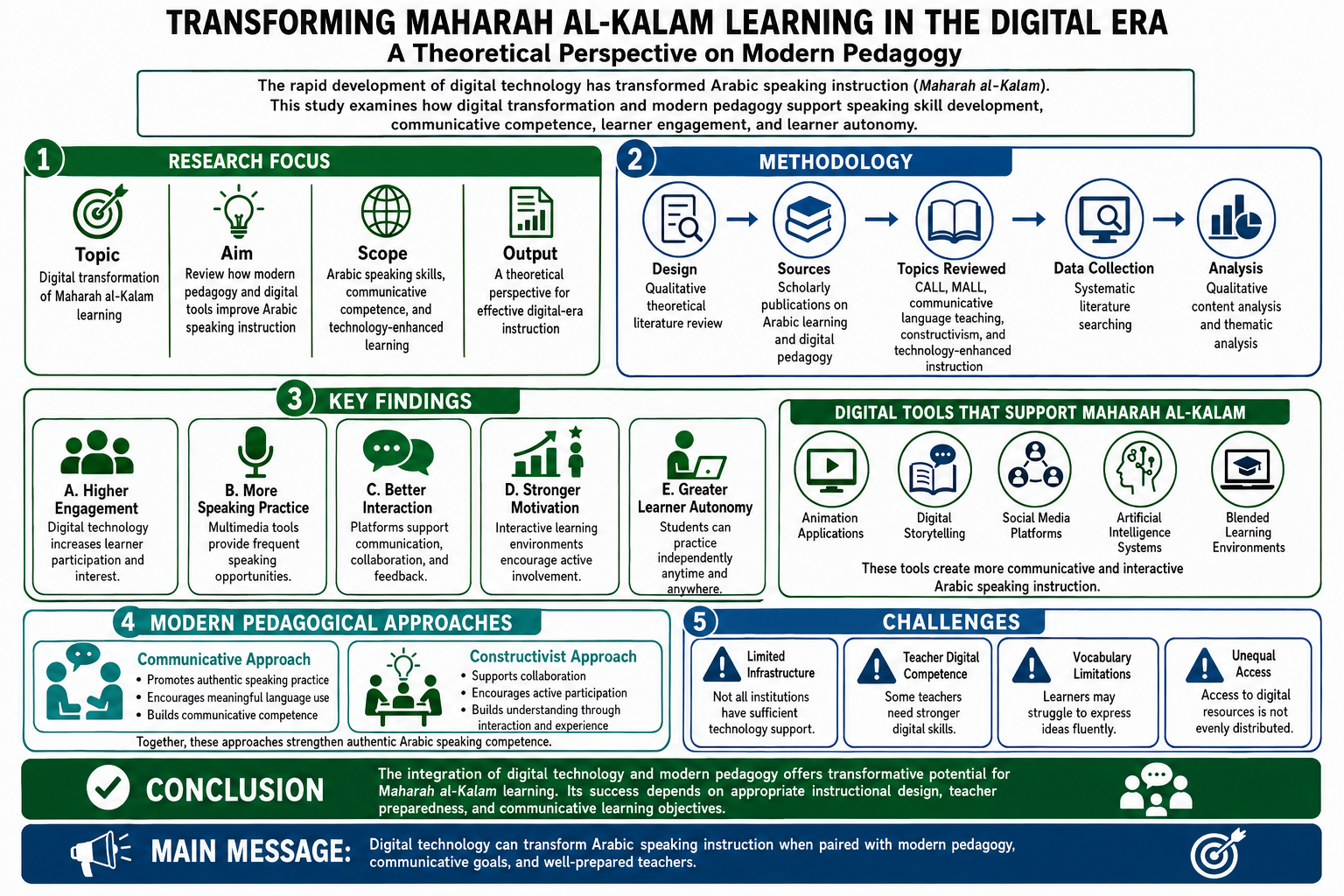
The rapid development of digital technology has transformed foreign language learning, including Arabic speaking instruction (Maharah al-Kalam). This study aims to examine the digital transformation of Maharah al-Kalam learning through a theoretical review of modern pedagogical approaches. The study explores how digital technologies, multimedia platforms, mobile learning, and learner-centered pedagogies contribute to the development of Arabic speaking skills and communicative competence. This research employed a qualitative theoretical literature review design by analyzing scholarly publications related to Arabic language learning, digital pedagogy, Computer-Assisted Language Learning, Mobile-Assisted Language Learning, communicative language teaching, and technology-enhanced instruction. The data were collected through systematic literature searching and analyzed using qualitative content analysis and thematic analysis. The findings reveal that digital technologies significantly improve learner engagement, speaking practice opportunities, interaction, motivation, and learner autonomy. Tools such as animation applications, digital storytelling, social media platforms, artificial intelligence systems, and blended learning environments create more communicative and interactive Arabic speaking instruction. Modern pedagogical approaches, particularly communicative and constructivist models, further support the development of authentic speaking competence by promoting collaboration, active participation, and meaningful language use. However, several challenges remain, including limited technological infrastructure, insufficient teacher digital competence, vocabulary limitations, and unequal access to digital resources. The study concludes that the integration of digital technology and modern pedagogy offers transformative potential for Maharah al-Kalam learning when supported by appropriate instructional design, teacher preparedness, and communicative learning objectives.
References
Abbasi, P. (2022). The Efficacy of Implementing C ALL Into EFL Settings. JSNDC, 2(1). https://doi.org/10.33140/jsndc.02.01.02
Abbasi, P. (2023). To Investigate Impacts of Implementing Multimedia Computer for EFL Students to Promote L2 Learning Gaps in Schools. Emergency and Nursing Management, 2(1). https://doi.org/10.58489/2836-2179/010
Abdulvahitoğlu, A. (2025). توظيف تقنيات الذكاء الاصطناعي في تطوير كفاءة التعلم الذاتي لمفردات اللغة العربية “منصة دليل العربية نموذجاً.” Balagh - Journal of Islamic and Humanities Studies, 5(2), 73–100. https://doi.org/10.65662/balagh.1771036
Abidah, S., & Febriani, S. R. (2022). Application of Clustering Method in Arabic Learning to Improve Speaking Skills for High School Levels. Tanwir Arabiyyah Arabic as Foreign Language Journal, 2(2), 109–122. https://doi.org/10.31869/aflj.v2i2.3456
Akkara, S., Anumula, V. S. S., & Mallampalli, M. S. (2020). Impact of WhatsApp Interaction on Improving L2 Speaking Skills. International Journal of Emerging Technologies in Learning (Ijet), 15(03), 250. https://doi.org/10.3991/ijet.v15i03.11534
Al-Abdulaziz, F., & Darwesh, A. Q. A. (2023). Cultivating Active Learning and Learner-Centered Pedagogical Practices on MOOCs. https://doi.org/10.5772/intechopen.1001059
Al-Amri, A. N. A. (2022). Saudi EFL University Students’ Perceived Linguistic Gains and Learning Experiences in Flipped Classrooms. Arab World English Journal, 8, 192–204. https://doi.org/10.24093/awej/call8.13
ALAMOUSH, A. I. S. (2022). The Effectiveness of a Computerized Educational Program in Developing Language Skills for the 3rd Grade Students With Learning Difficulties in the Arabic Language. Jep. https://doi.org/10.7176/jep/13-19-06
Alanazi, M. S. (2023). Innovation for All: Unleashing the Power of Assistive Technology in Special Education in Arabic-Speaking Countries. Journal of Icsar, 7(2), 178. https://doi.org/10.17977/um005v7i22023p178
Almelhes, S. A. (2024). Enhancing Arabic Language Acquisition: Effective Strategies for Addressing Non-Native Learners’ Challenges. Education Sciences, 14(10), 1116. https://doi.org/10.3390/educsci14101116
Almelhes, S. A., & Alsaiari, H. (2024). A Conceptual Framework for Teaching Arabic as a Second Language. Theory and Practice in Language Studies, 14(7), 2110–2118. https://doi.org/10.17507/tpls.1407.18
AlOkaily, R. (2021). Benefits and Barriers of Online Speaking Practice: A Case Study in the United Arab Emirates. https://doi.org/10.21428/8c225f6e.cf3e7823
Alzubi, A. M. (2023). The Role of Digital Media Technology in Arabic and English Classes in the Kingdom of Jordan. Alsuna Journal of Arabic and English Language, 6(1), 55–72. https://doi.org/10.31538/alsuna.v6i1.3419
Amrullah, M. K., Riwanda, A., Marsiah, M., & Wilailak, W. (2024). Elevating Arabic Speaking Skills: Plotagon and Digital Comics as Catalysts for Enhanced Learning Engagement and Proficiency. Al-Ta Rib Jurnal Ilmiah Program Studi Pendidikan Bahasa Arab Iain Palangka Raya, 12(1), 17–32. https://doi.org/10.23971/altarib.v12i1.7564
Andrian, R., & Yul, W. (2023). Arabic Teaching Efficacy Model (ATEM): A Language Teaching Model Design. International Journal of Arabic-English Studies, 23(2), 269–384. https://doi.org/10.33806/ijaes.v23i2.468
Aprianto, D., & Zaini, N. (2019). The Principles of Language Learning and Teaching in Communication Skill Developments. Veles Voice of English Language Education Society, 3(1). https://doi.org/10.29408/veles.v3i1.1281
Asbarin, A., Machmudah, U., Amalia, N. N., & Taufik, M. (2022). An Analysis on the Principles of Arabic Textbooks for Madrasah Aliyah in Indonesia: Based on the Ministry of Education and Rusydi Ahmad Thu’aimah. Al-Ta Rib Jurnal Ilmiah Program Studi Pendidikan Bahasa Arab Iain Palangka Raya, 10(2), 171–184. https://doi.org/10.23971/altarib.v10i2.4449
Aufi, A. A., Naqvi, S., & Naidu, V. R. (2023). Integrating Html5-Based Speech Recognition With Learning Management System to Enhance Efl Learners’ Pronunciation Skills. Journal of Teaching English for Specific and Academic Purposes, 507. https://doi.org/10.22190/jtesap230621038a
Az-Zahra, T. A., & Muhajir, M. (2023). Implementation of the Kurikulum Merdeka in Arabic Language Learning. Inovasi Kurikulum, 20(2), 261–274. https://doi.org/10.17509/jik.v20i2.59793
AZIZ, M. U. L. H. A. A. (2023). Lawful Instruction of Using Cali for Higher Secondary Level Students in Pakistan: The Post Covid-19 Context. Russian Law Journal, 11(7s). https://doi.org/10.52783/rlj.v11i7s.1229
Baharuddin, N. A., Abubakar, A., & Basri, H. (2023). The The Phohibition of Usury and Its Implications for the Economy. In ADL ISLAMIC ECONOMIC (Vol. 4, Issue 2, pp. 162–176). https://scholar.google.com/citations?view_op=view_citation&hl=en&user=IfiODt0AAAAJ&cstart=100&pagesize=100&citation_for_view=IfiODt0AAAAJ:olpn-zPbct0C
Baharudin, H., & Anuar, W. M. R. W. (2023). Humor Practises of Arabic Teachers and Speaking Anxiety. Ijaz Arabi Journal of Arabic Learning, 6(3). https://doi.org/10.18860/ijazarabi.v6i3.23359
Bambang, B., Tanjung, I., Ritonga, D. H., Hasibuan, L. P., & Pohan, A. H. (2023). Planning and Strategies for Maharah Al-Kalam Learning Arabic Language in Madrasah. Waraqat Jurnal Ilmu-Ilmu Keislaman, 8(1), 91–100. https://doi.org/10.51590/waraqat.v8i1.457
Chen, X. (2024). The Application of ChatGPT in Second Language (L2) Learning Classrooms: Opportunities and Challenges. Tssehr, 5, 132–137. https://doi.org/10.62051/hg1w7578
Chuah, K.-M., & Kabilan, M. K. (2022). The Development of Mobile Applications for Language Learning: A Systematic Review of Theoretical Frameworks. International Journal of Learning Teaching and Educational Research, 21(8), 253–270. https://doi.org/10.26803/ijlter.21.8.15
Crum, S., & Özçelik, Ö. (2024). Social Networks as Technology-Enhanced Learning Environments for Second Language Teaching in Higher Education. International Journal of Emerging Technologies in Learning (Ijet), 19(01), 4–22. https://doi.org/10.3991/ijet.v19i01.42013
Dinata, R. S., Musalwa, M., & Budiarti, M. (2021). Students’ Perceptions About Evaluation of Speaking Skills (Mahârah Kalâm) Through Youtube Channel. Lisaanuna Ta`lim Al-Lughah Al-Arabiyah Jurnal Pendidikan Bahasa Arab, 4(2), 221–232. https://doi.org/10.15548/lisaanuna.v4i2.3274
Dizon, G. (2017). Using Intelligent Personal Assistants for Second Language Learning: A Case Study of Alexa. Tesol Journal, 8(4), 811–830. https://doi.org/10.1002/tesj.353
Dovrat, L. (2022). Systematic Literature Review on the Utilization of Theoretical Underpinnings in Virtual Exchange Research. Journal of Virtual Exchange, 5, 193–212. https://doi.org/10.21827/jve.5.38444
ELHAOURI, L., ELALAMI, N. E., & ALAOUI, M. S. H. (2025). The Implementation of BENEYLU Platform in the Teaching and Learning Process of Arabic as a Foreign Language. مجلة ابتكارات للدراسات الإنسانية والاجتماعية, 3(1). https://doi.org/10.61856/gmmmf696
Epepe, U. D. (2022). Youtube and Second Life for Indigenous Language Learning: Awareness and Usage in Tertiary Education in Nigeria. American Journal of Communication, 4(1), 1–20. https://doi.org/10.47672/ajc.914
Eppard, J., Kaviani, A., Bowles, M., & Johnson, J. D. (2021). EdTech Culturation: Integrating a Culturally Relevant Pedagogy Into Educational Technology. The Electronic Journal of E-Learning, 19(6), pp516-530. https://doi.org/10.34190/ejel.19.6.2065
Fitrah, M. A., Hairuddin, H., & Miolo, M. I. (2023). The Effect of Modern Standard Arabic Books on Learning Outcomes of 2nd Semester Students of the Department of Arabic Language Education IAIN Sultan Amai Gorontalo. In Al-Kalim: Jurnal Pendidikan Bahasa Arab dan Kebahasaaraban (Vol. 2, Issue 2, pp. 189–201). https://scholar.google.com/citations?view_op=view_citation&hl=en&user=PH0io1QAAAAJ&pagesize=100&citation_for_view=PH0io1QAAAAJ:YOwf2qJgpHMC
Fuadah, S. (2021). Al-Tarjamah Al-Fauriyyah Method With Cognitive Learning Theory in Speaking Skills Learning. Alsinatuna, 7(1), 30–44. https://doi.org/10.28918/alsinatuna.v7i1.2850
Ghazali, F. A. (2020). Utilizing Social Networking Sites for Reinforcing the Linguistic Competence of EFL Learners. Journal of Language and Linguistic Studies. https://doi.org/10.17263/jlls.759252
Gottardi, W., Almeida, J. F. d., & Tumolo, C. H. S. (2022). Automatic Speech Recognition and Text-to-Speech Technologies for L2 Pronunciation Improvement. Texto Livre Linguagem E Tecnologia, 15, e36736. https://doi.org/10.35699/1983-3652.2022.36736
Handley, Z. (2024). Has Artificial Intelligence Rendered Language Teaching Obsolete? Modern Language Journal, 108(2), 548–555. https://doi.org/10.1111/modl.12929
Harnika, L., Abidin, Z., Maulana, M. I., Saputri, S., Salsabila, A. M. R. A., & Azim, A. (2024). Impact of Linguistic Environment on Speaking Skills of Female Students at the Arabic Language Center Islamic Boarding School in Indonesia. Jallt, 2(2), 121–136. https://doi.org/10.23971/jallt.v2i2.180
Hasibuan, R., Jundi, M., Ali, I., Febriani, S. R., & Bedra, K. G. (2024). Game-Based Language Learning: Implementing Arabic Speaking Proficiency Through Truth or Dare With Spin Wheel. Lughawiyah Journal of Arabic Education and Linguistics, 6(1), 16–33. https://doi.org/10.31958/lughawiyah.v6i1.12224
Heine, L., Marx, N., Schädlich, B., & Wilden, E. (2020). Review of Doctoral Research in Language Education in Germany (2014–2018). Language Teaching, 53(3), 341–357. https://doi.org/10.1017/s0261444820000063
Hieu, H. H., & Thao, L. T. (2024). Exploring the Impact of AI in Language Education: Vietnamese EFL Teachers’ Views on Using ChatGPT for Fairy Tale Retelling Tasks. International Journal of Learning Teaching and Educational Research, 23(3), 486–503. https://doi.org/10.26803/ijlter.23.3.24
Hosna, H., Firdaus, A. N. H., Mutmainnah, W., & Maulana, A. (2023). The Implementation of Authentic Assesment in Raising the Student’s Speaking Skill at Religius Programs (Manpk) Senior High School 01 Jember. Ethical Lingua Journal of Language Teaching and Literature, 10(2). https://doi.org/10.30605/25409190.637
Huseinović, L. (2023). The Effects of Gamification on Student Motivation and Achievement in Learning English as a Foreign Language in Higher Education. Map Education and Humanities, 4(1), 10–36. https://doi.org/10.53880/2744-2373.2023.4.10
Ibrahim, U., Attahiru, A., Muktar, A., & Bunza, K. U. (2024). Utilizing Digital Resources and Platforms to Enhance the Teaching of Arabic Language and Literature in Islamic Education. Ijels, 2(1), 17–34. https://doi.org/10.59890/ijels.v2i1.936
Ilmiani, A. M., & Miolo, M. I. (2021). Digital literacy: exploration of social media-based Arabic language learning. Journal of Applied Studies in Language. https://ojs2.pnb.ac.id/index.php/JASL/article/view/16
Ismail, M. R., Latif, K. A. A., & Ghazali, A. R. (2023). Analysis of the Need for Developing a Module on Writing Skills in Arabic Essays From the Perspective of Models and Teaching Methods of the Module. E-Jurnal Bahasa Dan Linguistik (E-Jbl), 5(1), 75–83. https://doi.org/10.53840/ejbl.v5i1.131
Kızıl, A. Ş., Klímová, B., Pikhart, M., & Parmaxi, A. (2025). A Systematic Review of the Recent Research on the Usefulness of Chatbots for Language Education. Journal of Computer Assisted Learning, 41(2). https://doi.org/10.1111/jcal.70001
Kristiawan, D., Bashar, K., & Pradana, D. A. (2024). Artificial Intelligence in English Language Learning: A Systematic Review of AI Tools, Applications, and Pedagogical Outcomes. The Art of Teaching English as a Foreign Language (Tatefl), 5(2), 207–218. https://doi.org/10.36663/tatefl.v5i2.912
Kurnia, F. A., Aprilia, R., Muhammad, H., & Fitriani, L. (2023). Utilization of Interactive Learning Media Based on the Plotagon Application in Learning Arabic Speaking Skills. Akademika, 12(02), 365–380. https://doi.org/10.34005/akademika.v12i02.3326
Languageacademy, Z. (2021). A Systematic Literature Review on the Use of Mobile-Assisted Language Learning (MALL) for Enhancing Speaking Skills in Chinese EFL Context. International Journal of Frontiers in Sociology, 3(15). https://doi.org/10.25236/ijfs.2021.031502
Larsari, V. N. (2024). Sustainable Development Education in Times of the Post Era: Challenges, Opportunities, and Strategies for Digital Transformation in Language Learning and Teaching. International Journal of Social Learning (Ijsl), 4(3), 404–420. https://doi.org/10.47134/ijsl.v4i3.290
Lysak, H. (2022). Implementation of Immersive Technologies in Foreign Language Learning: Analysis of Foreign and Domestic (Ukrainian) Experience. Comparative Professional Pedagogy, 12(1), 78–85. https://doi.org/10.31891/2308-4081/2022-12(1)-8
Makinde, S. O., Atotileto, A. A., & Sulyman, M. B. (2024). Proposal to Develop and Validate a Moodle-Based Flipped Learning Platform for Enhancing Arabic Communication Skills. International Journal of Indonesian Education and Teaching, 8(2), 207–222. https://doi.org/10.24071/ijiet.v8i2.8075
Mamnunah, M., Syihabuddin, S., & Nurbayan, Y. (2021). Policy Implementation of the Sabilillah Spectacular Stage (Sss) Program to Increase Students’ Speaking Skills. Arabiyat Jurnal Pendidikan Bahasa Arab Dan Kebahasaaraban, 8(1), 106–117. https://doi.org/10.15408/a.v8i1.20661
Mansor, M. N. S., & Baharudin, H. (2023). Technological Knowledge and Self-Efficacy of Primary School Arabic Teachers in Teaching and Learning at Home (PDPR). International Journal of Academic Research in Business and Social Sciences, 13(7). https://doi.org/10.6007/ijarbss/v13-i7/17849
Marlius, Y., Bambang, B., & Wirman, M. (2021). The Efforts to Improve Students’ Arabic Speaking Skills Through Language Environment Activation: A Study of Phenomenology. Al-Ta Rib Jurnal Ilmiah Program Studi Pendidikan Bahasa Arab Iain Palangka Raya, 9(1), 35–48. https://doi.org/10.23971/altarib.v9i1.2585
Metruk, R. (2024). Mobile-Assisted Language Learning and Pronunciation Instruction: A Systematic Literature Review. Education and Information Technologies, 29(13), 16255–16282. https://doi.org/10.1007/s10639-024-12453-0
Miolo, M. I., Damhuri, Batalipu, A., & Talibo, W. (2025). Pembelajaran Maharatul Kalam: Teori dan Praktik. CV. Al-Haramain Lombok.
Miolo, M. I., Mamonto, M. Z., & Aprianda, M. (2025). Pengembangan Media Pembelajaran Bahasa Arab di Era Digital. CV. Al-Haramain Lombok.
Mirza, Z. A., Humayun, S., & Zohaib, Q. (2023). Investigating the Effectiveness of Call for the English Language Learner. European Journal of Linguistics, 2(2), 32–51. https://doi.org/10.47941/ejl.1342
Mizel, O. (2020). Degree of Adaptation of Jerusalem Palestinian Students at Israeli Academic Colleges. Contemporary Review of the Middle East, 7(4), 403–430. https://doi.org/10.1177/2347798920939839
Mohammed, T. A. S. (2022). Designing an Arabic Speaking and Listening Skills E- Course: Resources, Activities and Students’ Perceptions. The Electronic Journal of E-Learning, 20(1), pp53-68. https://doi.org/10.34190/ejel.20.1.2177
Mohsen, M. A., Althebi, S., Alsagour, R., Alsalem, A., Almudawi, A., & Alshahrani, A. (2023). Forty-Two Years of Computer-Assisted Language Learning Research: A Scientometric Study of Hotspot Research and Trending Issues. Recall, 36(2), 230–249. https://doi.org/10.1017/s0958344023000253
Moxon, S. (2021). Exploring the Effects of Automated Pronunciation Evaluation on L2 Students in Thailand. Iafor Journal of Education, 9(3), 41–57. https://doi.org/10.22492/ije.9.3.03
Mubarak, M. R., Wahdah, N., Ilmiani, A. M., & Hamidah, H. (2020). Penggunaan Vlog Dalam Pembelajaran Mahārah Kalām. Al Mi Yar Jurnal Ilmiah Pembelajaran Bahasa Arab Dan Kebahasaaraban, 3(1), 109. https://doi.org/10.35931/am.v3i1.209
Mufidah, N., Abdussalam, A. A., & Adebisi, A. A. (2019). Foreign Language Teaching and Information Communication Technology: Is There Opportunity for Quranic Language Teachers? Hunafa Jurnal Studia Islamika, 16(1), 33–53. https://doi.org/10.24239/jsi.v16i1.526.34-55
Mustaffa, N. U. C., & Sailin, S. N. (2022). A Systematic Review of Mobile-Assisted Language Learning Research Trends and Practices in Malaysia. International Journal of Interactive Mobile Technologies (Ijim), 16(05), 169–198. https://doi.org/10.3991/ijim.v16i05.28129
Ndayishimiye, E., Ngabonziza, J. de D. A., & Ngirabakunzi, S. N. (2024). The Effect of Gamification on Learners’ English-Speaking Skills Performance: A Case of Five Selected High Schools in Kicukiro District, Rwanda. African Journal of Empirical Research, 5(3), 797–812. https://doi.org/10.51867/ajernet.5.3.68
Nuraini, A., Jundi, M., Hasibuan, R., & Djola, F. (2024). Student Progress Tracing of Arabic Learning: A Qualitative Investigation of Speaking Skills Formative Evaluation in Islamic Elementary School. Jurnal Al-Ihda Media Ilmiah Bahasa Arab, 12(1). https://doi.org/10.58645/alihda.v12i1.520
O’Brien, M. G., Derwing, T. M., Cucchiarini, C., Hardison, D. M., Mixdorff, H., Thomson, R. I., Strik, H., Levis, J. M., Munro, M. J., Foote, J. A., & Levis, G. M. (2022). Directions for the Future of Technology in Pronunciation Research and Teaching. Journal of Second Language Pronunciation, 182–207. https://doi.org/10.1075/jslp.17001.obr
Palioura, M., & Dimoulas, C. (2022). Digital Storytelling in Education: A Transmedia Integration Approach for the Non-Developers. Education Sciences, 12(8), 559. https://doi.org/10.3390/educsci12080559
Perez, E., Manca, S., Fernández-Pascual, R., & Guckin, C. M. (2023). A Systematic Review of Social Media as a Teaching and Learning Tool in Higher Education: A Theoretical Grounding Perspective. Education and Information Technologies, 28(9), 11921–11950. https://doi.org/10.1007/s10639-023-11647-2
Ritonga, N., Putra, W. H., & Isnaini, R. L. (2024). Ṭarīqah Mubāsyarah in the Learning of Arabic Speaking Skill: Study Analysis With Al-Iṭṭiṣāli Approach. Al-Ta Rib Jurnal Ilmiah Program Studi Pendidikan Bahasa Arab Iain Palangka Raya, 12(1), 203–214. https://doi.org/10.23971/altarib.v12i1.8092
Rogerson‐Revell, P. (2021). Computer-Assisted Pronunciation Training (CAPT): Current Issues and Future Directions. Relc Journal, 52(1), 189–205. https://doi.org/10.1177/0033688220977406
Rufaiqoh, E., Sutiah, S., Ulum, S., Yaqin, M. A., Nuruddin, A., & Aloraini, M. A. M. (2024). An Analysis of Arabic Language Curriculum Development in Indonesia. Jurnal Al-Maqayis, 11(1), 1–16. https://doi.org/10.18592/jams.v11i1.9843
Sa’diyah, H., & Alfian, M. I. (2021). Whatsapp Small Groups Sebagai Media Pembelajaran Maharah Al-Kalam Di Masa DARING. Arabia, 13(1), 1. https://doi.org/10.21043/arabia.v13i1.10217
Saylan, E., Kokoç, M., & TATLI, Z. (2023). A Systematic Review of Empirical Studies on Computer-Assisted Language Learning. Waikato Journal of Education, 28(1). https://doi.org/10.15663/wje.v28i1.1091
Setiyadi, A. C., Hidayah, N., Wahyudi, M., & Maha, M. B. (2023). Bī’ah Lughawiyah Programs in Arabic Language Learning to Improve Student’s Arabic Speaking Skills. Ta Lim Al- Arabiyyah Jurnal Pendidikan Bahasa Arab & Kebahasaaraban, 7(1), 29–46. https://doi.org/10.15575/jpba.v7i1.24173
Shalaby, E. A., & Badr, S. (2024). Enhancing EFL Speaking Skills of Secondary School Students Through a Constructivist Learning Activities (CLAs) Program. Port Said Journal of Educational Research, 3(1), 138–168. https://doi.org/10.21608/psjer.2023.243563.1023
Sidgi, L. F. S., & Shaari, A. J. (2017). The Usefulness of Automatic Speech Recognition (ASR) Eyespeak Software in Improving Iraqi EFL Students’ Pronunciation. Advances in Language and Literary Studies, 8(1), 221. https://doi.org/10.7575/aiac.alls.v.8n.1p.221
Șișianu, A., & Pușcașu, A. (2024). New Technologies and Foreign Language Learning: Transforming Language Education. Journal of Social Sciences, 7(1), 91–99. https://doi.org/10.52326/jss.utm.2024.7(1).07
Souheyla, B., & Benmansour, N. (2022). Taking the Wave of Digitalization: Reflection on the Psychological Readiness of Teachers in Using Information and Communication Technologies. Arab World English Journal, 8, 121–135. https://doi.org/10.24093/awej/call8.8
Sujefri, A., & Habibah, I. F. (2023). Analysis of Needs to Learn Arabic Through Instagram. International Journal of Arabic Language Teaching, 5(02), 245. https://doi.org/10.32332/ijalt.v5i02.7180
Sutomo, N. (2024). The Implementation of Automated Speech Recognition (ASR) in ELT Classroom: A Systematic Literature Review From 2012-2023. Veles Voice of English Language Education Society, 7(3), 816–828. https://doi.org/10.29408/veles.v7i3.23978
Syah, B. L., Safari, M., & Ulwan, R. A. (2023). Implementation of Digital Story Telling (DST) Strategy in Arabic Learning (Case Study at Arrifaie Gondanglegi Middle School Malang). Insyirah Jurnal Ilmu Bahasa Arab Dan Studi Islam, 6(1), 145–156. https://doi.org/10.26555/insyirah.v6i1.8058
Syaikhudin, M., & Laili, M. (2024). Development of AI-based Arabic Learning Model to Improve Non-Native Speaker Arabic Speaking Skills. Syaikhuna Jurnal Pendidikan Dan Pranata Islam, 15(01), 25–33. https://doi.org/10.62730/syaikhuna.v15i01.7295
Szabó, F., & Csépes, I. (2023). Constructivism in Language Pedagogy. The Hungarian Educational Research Journal, 13(3), 405–417. https://doi.org/10.1556/063.2022.00136
Tabasi, Y., Tondowala, I. B., Tupamahu, M. S., Sigilipu, F. P. S., & Septiana, K. A. K. (2024). The Effectiveness of Technology-Enhanced Learning Tools in English Language Education. Journal on Education, 6(4), 21589–21601. https://doi.org/10.31004/joe.v6i4.6308
Talpur, N., Kalwar, T., & Talpur, M. J. (2021). Computer-Assisted Language Learning in Pakistani Context During COVID-19 Pandemic. Reila Journal of Research and Innovation in Language, 3(3), 210–225. https://doi.org/10.31849/reila.v3i3.6908
Tseng, W., Chen, S., Wang, S.-P., Cheng, H.-F., Yang, P., & Gao, X. (2022). The Effects of MALL on L2 Pronunciation Learning: A Meta-Analysis. Journal of Educational Computing Research, 60(5), 1220–1252. https://doi.org/10.1177/07356331211058662
Ulum, M., & Hadawiah, L. (2022). Pendekatan Andragogi Dalam Pembelajaran Maharah Al-Kitabah Di LPBA Nurul Jadid. Al-Fusha Arabic Language Education Journal, 4(2), 37–44. https://doi.org/10.62097/alfusha.v4i2.826
Umam, M. K., Nawangsari, A. L. F., & Firdausah, I. (2023). Non-Test Portfolio Assessment Techniques: Innovation to Improve Maharah Al-Kitabah. Nusantara Jurnal Pendidikan Indonesia, 3(3), 351–370. https://doi.org/10.14421/njpi.2023.v3i3-1
Vančová, H. (2023). AI and AI-powered Tools for Pronunciation Training. Journal of Language and Cultural Education, 11(3), 12–24. https://doi.org/10.2478/jolace-2023-0022
Wachidah, H. N. (2023). Digital Visual Literacy: Penggunaan Digital Book Creator Sebagai Media Pengembangan Bahan Ajar Bahasa Arab (Maharah Kalam) Terhadap Mahasiswa Di Lingkungan Pendidikan Tinggi. Ukazh Journal of Arabic Studies, 4(2), 533–549. https://doi.org/10.37274/ukazh.v4i2.857
Wahyuni, S., Ritonga, M., Fitriani, R., Pitrianto, H., & Adam, Z. (2023). Arabic Speaking Skill Learning Using Word Chain Game in Madrasah. Izdihar Journal of Arabic Language Teaching Linguistics and Literature, 6(2). https://doi.org/10.22219/jiz.v6i2.28192
Wang, M., & Devitt, A. (2022). A Systematic Review of Computer-Mediated Communications in Chinese as a Foreign Language From 2008 to 2022: Research Contexts, Theoretical Foundations and Methodology, Affordances and Limitations. Language Teaching Research, 30(1), 36–64. https://doi.org/10.1177/13621688221132475
Weng, Y., Schmidt, M., Huang, W., & Hao, Y. (2024). The Effectiveness of Immersive Learning Technologies in K–12 English as Second Language Learning: A Systematic Review. Recall, 36(2), 210–229. https://doi.org/10.1017/s0958344024000041
Yaacob, M., & Bakar, K. A. (2018). Student-Centered Teaching Approach Combined With Coaching and Mentoring Elements in Arabic Language Speaking Proficiency. Oalib, 05(06), 1–11. https://doi.org/10.4236/oalib.1104684
Yusuf, A. H. S. M., Maulan, S., Hoo, J. F., Jailani, A. I., & Ayob, N. M. (2021). A Thematic Analysis of Online Learning Experiences Among Students of a Language Programme: Instructors’ Delivery and Peer Interaction. International Journal of Academic Research in Business and Social Sciences, 11(6). https://doi.org/10.6007/ijarbss/v11-i6/10387
Zhang, Y., & Dong, C. (2024). Unveiling the Dynamic Mechanisms of Generative AI in English Language Learning: A Hybrid Study Based on fsQCA and System Dynamics. Behavioral Sciences, 14(11), 1015. https://doi.org/10.3390/bs14111015
Zuo, X., & Ives, D. (2023). Technology-Assisted Reading Instruction for English Language Learners: A Methodological Review. Ecnu Review of Education, 7(2), 258–282. https://doi.org/10.1177/20965311231179490
ضاهر, ر. م. ر. (2023). The Future of Education With Artificial Intelligence and Machine Learning in the Arab World: A Systemat. العلوم التربوية, 31(3), 1–35. https://doi.org/10.21608/ssj.2023.344574
Downloads
Published
How to Cite
Issue
Section
License
Copyright (c) 2026 al-Kalim: Jurnal Pendidikan Bahasa Arab dan Kebahasaaraban

This work is licensed under a Creative Commons Attribution-ShareAlike 4.0 International License.