أسلوب الاستعارة في الجزء الثامن والعشرين من القرآن الكريم: دراسة بلاغية تحليلية
DOI:
https://doi.org/10.60040/jak.v4i2.269Keywords:
الاستعارة, البلاغة العربية, الجزء الثامن والعشرون, علم البيان, القرآن الكريمAbstract
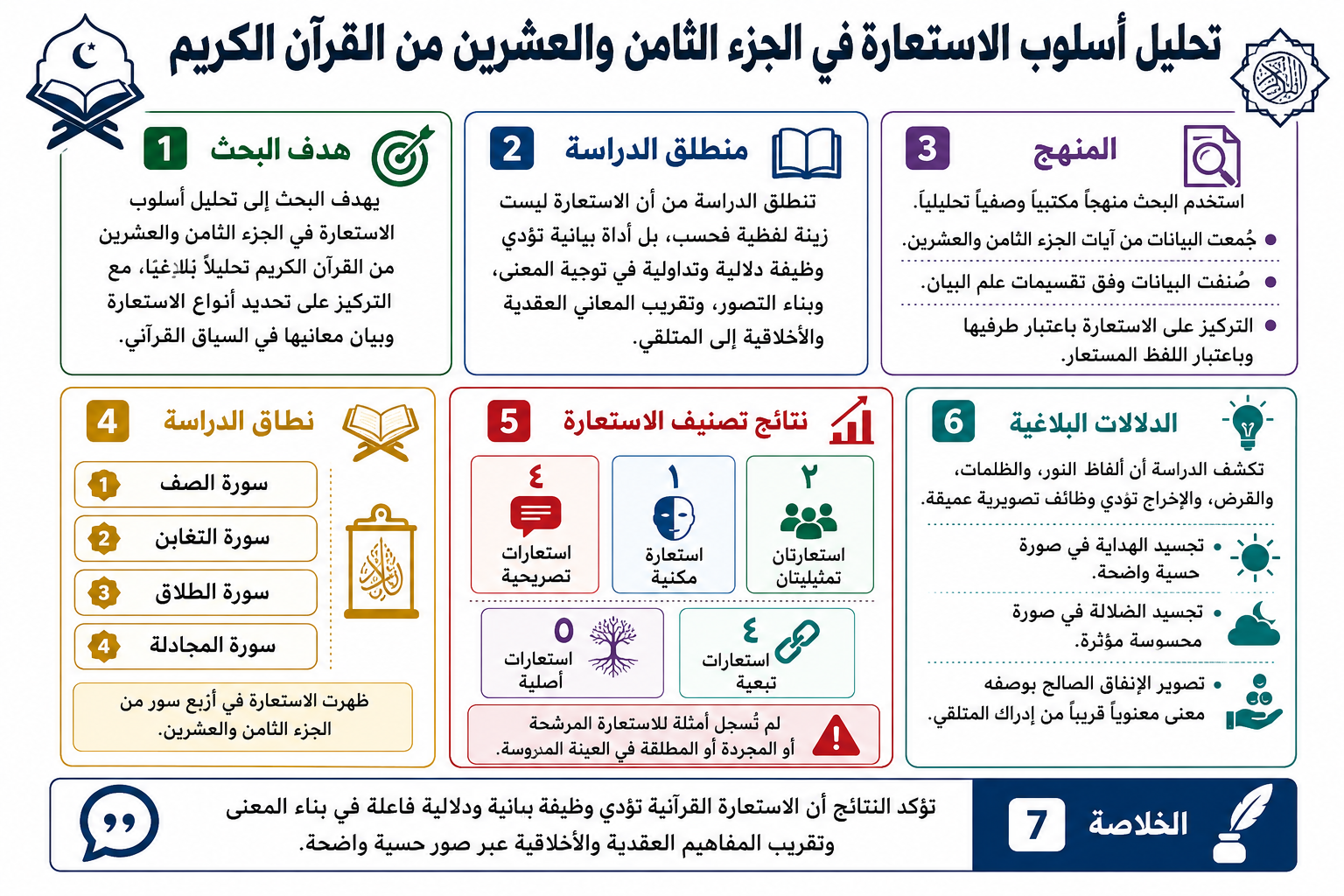
يهدف هذا البحث إلى تحليل أسلوب الاستعارة في الجزء الثامن والعشرين من القرآن الكريم تحليلاً بلاغياً، مع التركيز على تحديد أنواع الاستعارة وبيان معانيها في السياق القرآني. تنطلق الدراسة من أن الاستعارة ليست زينة لفظية فحسب، بل أداة بيانية تؤدي وظيفة دلالية وتداولية في توجيه المعنى، وبناء التصور، وتقريب المعاني العقدية والأخلاقية إلى المتلقي. استخدم البحث منهجاً مكتبياً وصفياً تحليلياً، إذ جُمعت البيانات من الآيات القرآنية في الجزء الثامن والعشرين، ثم صُنفت وفق تقسيمات علم البيان، ولا سيما الاستعارة باعتبار طرفيها وباعتبار اللفظ المستعار. أظهرت النتائج وجود الاستعارة في أربع سور، هي: الصف، والتغابن، والطلاق، والمجادلة. وبلغت الاستعارات المصنفة أربع استعارات تصريحية، واستعارة مكنية واحدة، واستعارتين تمثيليتين، وخمس استعارات أصلية، وأربع استعارات تبعية، بينما لم تُسجل أمثلة للاستعارة المرشحة أو المجردة أو المطلقة في العينة المدروسة. وتكشف الدراسة أن ألفاظ النور والظلمات والقرض والإخراج تؤدي وظائف تصويرية عميقة، إذ تجعل الهداية والضلالة والإنفاق الصالح حقائق معنوية حاضرة في صورة حسية واضحة.
References
Abdul-Raof, H. (2004). Qur’anic stylistics: A linguistic analysis. Lincom Europa.
Abdul-Raof, H. (2006). Arabic rhetoric: A pragmatic analysis. Routledge. https://www.routledge.com/Arabic-Rhetoric-A-Pragmatic-Analysis/Abdul-Raof/p/book/9780415386098
Abdul-Raof, H. (2018). Text linguistics of Qur’anic discourse: An analysis. Routledge. https://www.routledge.com/Text-Linguistics-of-Quranic-Discourse-An-Analysis/Abdul-Raof/p/book/9781138080706
Arsyad, B. 2020. “Makna Gramatikal Huruf Mā (ما) Dalam Surah Al-Baqarah.” in Prosiding Konferensi Nasional Bahasa Arab. Jawa Timur Malang: prosiding.arab-um.com.
Arsyad, B., C. P. Doni, S. R. Saleh, N. A. Pakaya, and ... 2021. “IMPROVING THE ABILITY TO READ THE AL-QUR’AN WITH THE BITHĀQATU AL-KALIMAH GAME METHOD.” Jurnal Ipteks …. doi: https://doi.org/10.22216/jit.v%25vi%25i.435.
Arsyad, B., S. Garancang, A. Kasim, and ... 2024. “Stilistika Al-Qur’an: Kajian Ma’ani Dan Badi Terhadap Penggunaan Uslub Al-Iltifāt Al-Șarfī.” A Jamiy: Jurnal … 13(2):252–69. doi: https://dx.doi.org/10.31314/ajamiy.13.1.252-269.2024.
Arsyad, B., H. Haniah, and A. Kasim. 2024. “Uslūb Al-Iltifāt In Surah Al Baqarah: Ma’ani Analysis on the Transition of the Use of First Person to Third Person.” in International …. Makassar: proceedings.uin-alauddin.ac.id.
Arsyad, Berti. 2024. “Uslub Al-Iltifat Dalam Al-Qur’an (Analisis Ma’ani Dan Badi’).” Pascasarjana UIN Alauddin Makassar
Al-Jurjānī, ʿA. al-Q. (2001). Asrār al-balāghah fī ʿilm al-bayān. Dār al-Kutub al-ʿIlmiyyah.
Al-Jurjānī, ʿA. al-Q. (2004). Dalāʾil al-iʿjāz fī al-Qurʾān (M. M. Shākir, Ed.). Dār al-Khānjī.
Al-Qazwīnī, J. al-D. (2013). Al-Īḍāḥ fī ʿulūm al-balāghah: Al-maʿānī, al-bayān, wa-al-badīʿ. Dār al-Kutub al-ʿIlmiyyah.
Al-Sakkākī, Y. ibn A. B. (2000). Miftāḥ al-ʿulūm. Dār al-Kutub al-ʿIlmiyyah.
Charteris-Black, J. (2004). Corpus approaches to critical metaphor analysis. Palgrave Macmillan. https://doi.org/10.1057/9780230000612
Ilmiani, Aulia Mustika, and Mukhtar I. Miolo. 2021. “Digital Literacy: Exploration of Social Media-Based Arabic Language Learning.” Journal of Applied Studies in Language 5(2). doi: 10.31940/jasl.v5i2.215-221.
Kövecses, Z. (2020). Extended conceptual metaphor theory. Cambridge University Press. https://doi.org/10.1017/9781108859127
Lakoff, G., & Johnson, M. (1980). Metaphors we live by. University of Chicago Press. DOI not assigned/verified for the original edition.
Marathe, M. (2025). Creation of a numerical scoring system to objectively measure and compare the level of rhetoric in Arabic texts: A feasibility study, and a working prototype. arXiv. DOI not assigned. https://arxiv.org/abs/2507.21106
Miolo, M I, J. Monantun, A. W. Mamonto, and M. Lahay. 2023. “Pelatihan Nahwu Dan Bahasa Al-Qur’an: Membangun Kemampuan Berbahasa Arab Dengan Mind Mapping Pada Siswa MAN 1 Kotamobagu.” Mohuyula: Jurnal Pengabdian ….
Miolo, M I, N. R. Paneo, A. A. Ismail, and H. Hilwa. 2023. “Perkembangan Sastra Arab Jahiliyyah Hingga Abbasiyah Serta Perannya Terhadap Peradaban Dunia.” A Jamiy: Jurnal Bahasa Dan Sastra Arab.
Miolo, Mukhtar I., Chendra Makalalag, and Rabiatul Adawiyah. 2023. “Revitalisasi Bahasa Al-Qur’an: Meningkatkan Kemampuan Berbahasa Arab Di MAN 1 Kotamobagu Melalui Arabic Camp.” Mohuyula : Jurnal Pengabdian Kepada Masyarakat 2(2):22–29. doi: http://dx.doi.org/10.31314/mohuyula.2.2.22-29.2023.
Neuwirth, A. (2019). The Qur’an and late antiquity: A shared heritage. Oxford University Press. DOI not verified. https://global.oup.com/academic/product/the-quran-and-late-antiquity-9780199928958
Pragglejaz Group. (2007). MIP: A method for identifying metaphorically used words in discourse. Metaphor and Symbol, 22(1), 1–39. https://doi.org/10.1080/10926480709336752
Paputungan, M., D. D. Noor, and M. I. Miolo. 2023. “Bentuk-Bentuk Kesalahan Fonologi Dalam Membaca Teks Arab Siswa Kelas VIII Di MTs Negeri 1 Kota Gorontalo.” A Jamiy: Jurnal Bahasa Dan Sastra Arab.
Sa’idah, T. N., and M. I. Miolo. 2025. “The Effect of the Use of Domino Arabic Media on the Mastery of Arabic Vocabulary of Grade VII Students MTs Negeri 1 Gorontalo City.” Assuthur: Jurnal Pendidikan … 4(1):13–22
Semino, E. (2008). Metaphor in discourse. Cambridge University Press. https://doi.org/10.1017/CBO9780511816802
Smyth, W. (1992). Controversy in a tradition of commentary: The academic legacy of al-Sakkākī’s Miftāḥ al-ʿUlūm. Journal of the American Oriental Society, 112(4), 589–597. DOI not verified.
Steen, G. J., Dorst, A. G., Herrmann, J. B., Kaal, A., Krennmayr, T., & Pasma, T. (2010). A method for linguistic metaphor identification
Downloads
Published
How to Cite
Issue
Section
License
Copyright (c) 2026 Oyan Pakaya, Sriwahyuningsih R. Saleh, Chaterina P. Doni, Berti Arsyad, Nurul Aini Pakaya

This work is licensed under a Creative Commons Attribution-ShareAlike 4.0 International License.