Iltifāt dalam Balāghah Arab: Genealogi Terminologis dan Model Identifikasi Operasional
DOI:
https://doi.org/10.60040/jak.v4i2.279Keywords:
balāghah Arab, iltifāt, pergeseran wacana, stilistika Al-Qur’an, terminologi retorisAbstract
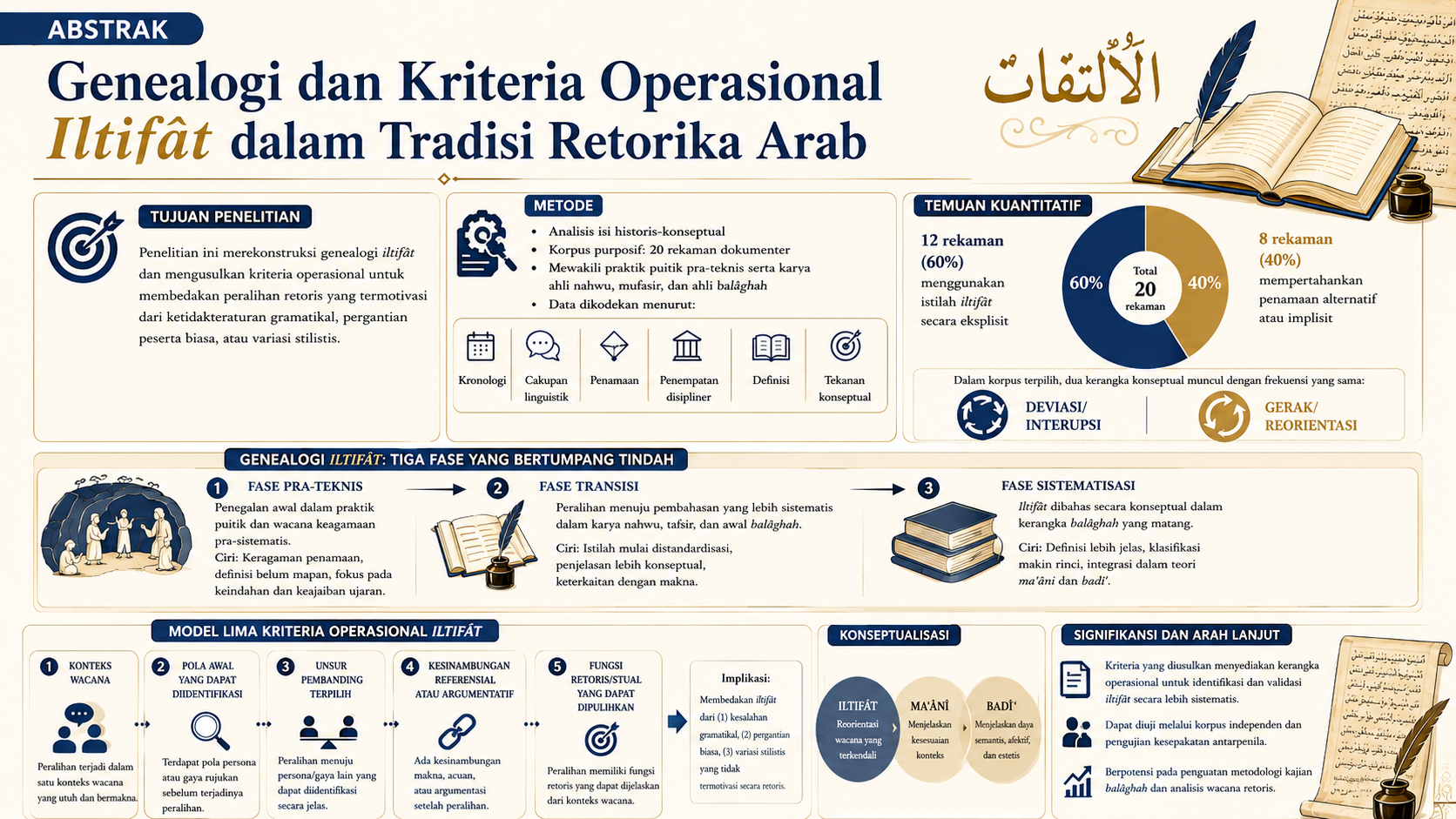
Kajian balāghah sering mendefinisikan iltifāt sebagai peralihan antara persona pertama, kedua, dan ketiga, padahal tradisi retorika Arab merekam sejarah yang lebih luas dan tidak stabil secara terminologis. Penelitian ini merekonstruksi genealogi iltifāt serta mengusulkan kriteria operasional untuk membedakan peralihan retoris yang termotivasi dari ketidakteraturan gramatikal, pergantian peserta biasa, atau variasi stilistis. Analisis isi historis-konseptual diterapkan pada korpus yang dipilih secara purposif berupa 20 rekaman dokumenter yang mewakili praktik puitik pra-teknis serta karya ahli nahwu, mufasir, dan ahli balāghah. Data dikodekan menurut kronologi, penamaan, definisi, cakupan linguistik, penempatan disipliner, dan tekanan konseptual. Sebanyak 12 rekaman (60%) menggunakan istilah iltifāt secara eksplisit, sedangkan delapan rekaman (40%) mempertahankan penamaan alternatif atau implisit. Dalam korpus terpilih, dua kerangka konseptual muncul dengan frekuensi yang sama, yaitu deviasi/interupsi dan gerak/reorientasi. Genealogi berkembang melalui tiga fase yang bertumpang tindih, dari pengenalan pra-teknis dan keragaman penamaan menuju sistematisasi konseptual yang semakin jelas. Berdasarkan rekonstruksi tersebut, penelitian ini mengusulkan model lima kriteria: satu konteks wacana, pola awal yang dapat diidentifikasi, unsur pembanding terpilih, kesinambungan referensial atau argumentatif, serta fungsi kontekstual yang dapat dipulihkan. Dengan demikian, iltifāt dapat dikonseptualisasikan sebagai reorientasi wacana yang terkendali; maʿānī menjelaskan kesesuaian konteksnya, sedangkan badīʿ menjelaskan daya semantis, afektif, dan estetisnya. Kriteria yang diusulkan menyediakan kerangka untuk validasi lebih lanjut melalui korpus independen dan pengujian kesepakatan antarpenilai.
References
Abdul-Latif, E. (2023). Verifying the Terminology of Arabic Rhetorical Tradition: The Case of ʾIltifāt. Lexikos, 33, 448–473. https://doi.org/10.5788/33-1-1831
Abū Zayd, K. (1988). ʿIlm al-maʿānī: Dirāsah wa-taḥlīl. Maktabat Wahbah.
Ahmad, H., & Ghafar, N. A. (2026). ELLIPTICAL ELOQUENCE IN THE QUR’AN: A FRAMEWORK FOR RHETORICAL-STYLISTIC AND DIGITAL TAFSIR. Quranica, 18(2), 208–229. https://doi.org/10.22452/quranica.vol18no1.27
Al-Anazi, R. G., Nashir, W. A., Al-Onazi, B. B., Alhamad, A. A., Alshamrani, H., & Bin Subait, W. F. (2026). Deep Rhetoric: A Qarīna-Aware Multi-Task Learning Framework for Hierarchical Analysis of Qur’anic Metaphor. IEEE Access, 14, 84732–84754. https://doi.org/10.1109/ACCESS.2026.3696593
Al-Baḥīrī, U. (2006). Taysīr al-balāghah: ʿIlm al-badīʿ.
Al-Farrāʾ, A. Z. Y. ibn Z. (1955). Maʿānī al-Qurʾān (A. Y. Najātī & M. ʿA. al-Najjār, Eds.; Vol. 3). Dār al-Kutub al-Miṣriyyah.
Al-Fattāḥ, B. ʿA. (1998). ʿIlm al-maʿānī: Dirāsah balāghiyyah wa-naqdiyyah li-masāʾil al-maʿānī. Muʾassasat al-Mukhtār.
Al-Hamzi, A. M. S. (2026). Translation shifts of Quranic conjunctive relations in English: Insights from the Musa–Pharaoh narrative. Cogent Arts and Humanities, 13(1). https://doi.org/10.1080/23311983.2025.2604955
Al-Hāshimī, S. A. (n.d.). Jawāhir al-balāghah fī al-maʿānī wa-al-bayān wa-al-badīʿ. Dār Ibn Khaldūn.
Al-Marāqī, M. A. Ḥ. (1991). Fī al-balāghah al-ʿArabiyyah: ʿIlm al-badīʿ. Dār al-ʿUlūm al-ʿArabiyyah.
Al-Muṭṭalib, M. ʿA. (1994). Al-balāghah al-uslūbiyyah. Maktabat Lubnān Nāshirūn.
Al-Qazwīnī, J. al-D. M. ibn ʿA. al-R. (1904). Al-Talkhīṣ fī ʿulūm al-balāghah (ʿA. al-R. al-Barqūqī, Ed.). Dār al-Fikr al-ʿArabī.
Al-Sharafi, A. G., & Ahmad, R. (2022). Translating the sacred Agency in translating verb-noun alternation in the Qur’an. Babel, 68(3), 317–340. https://doi.org/10.1075/babel.00273.sha
Al-Zamakhsharī. (n.d.). Al-Kashshāf ʿan ḥaqāʾiq al-tanzīl wa-ʿuyūn al-aqāwīl fī wujūh al-taʾwīl (Vol. 1). Dār al-Maʿrifah.
Al-Zarkashī, B. al-D. M. ibn ʿA. (1984). Al-Burhān fī ʿulūm al-Qurʾān (3rd ed.). Dār al-Turāth.
Aljahsh, M. A. I. (2026). Iḥtibāk, Reciprocal Ellipsis, in the Qur’an: A Comparative Rhetorical and Translation Study. Traduction et Langues, 25(1), 47–68.
Alkhafaji, K. H. J., & Albakhitawi, E. M. M. (2026). The Method of Al-Babarti and Tabrizi of Explanation on the Book of Al-Talkhis of al-Qazwini: A Balancing Study. Dirasat: Human and Social Sciences, 53(3). https://doi.org/10.35516/Hum.2025.8426
Alsemeiri, I. M., & Nordin, M. Z. F. (2023). The Intricate Nature of Kināyah and Its Interaction with Other English Figures of Speech. GEMA Online Journal of Language Studies, 23(4), 95–114. https://doi.org/10.17576/gema-2023-2304-06
Alturki, M. M. (2025). The Translation of Repetition in Arabic Religious Discourse Into English: The Case of the Quran. Theory and Practice in Language Studies, 15(7), 2239–2247. https://doi.org/10.17507/tpls.1507.16
Asnawi, A. R. (2020). Gaya bahasa iltifāt dalam ayat-ayat ʿitāb dan pengaruhnya bagi penafsiran Al-Qurʾan. AL QUDS: Jurnal Studi Alquran dan Hadis, 4(2), 299. https://doi.org/10.29240/alquds.v4i2.1854
Bettahar, B. (2026). Al-Sakaki’s Rhetoric in the View of Scholars between Denial and Support. Dirasat: Human and Social Sciences, 53(3). https://doi.org/10.35516/Hum.2025.8820
Damhuri. (2016). Uslūb al-Qurʾān perspektif balāghah: Analisis terhadap al-iltifāt al-muʿjamī [Doctoral dissertation, UIN Alauddin Makassar].
Fontana, C. (2024). Al-Balāghah’s Legacy in Modern Secular Journalism Al-Risālah’s (1933–1953) Case. Journal of Arabic Literature, 55(4), 488–525. https://doi.org/10.1163/1570064X-12341538
Gabareen, N., & Al-Khaldi, M. (2025). Embedding According to Al-Zamakhshari in His Interpretation: An Applied Study on Surat Al-Baqarah. An-Najah University Journal for Research - B (Humanities), 39(2), 69–80. https://doi.org/10.35552/0247.39.2.2320
Ghazal, G. A. S. (2026). QUR’ĀNIC HERMENEUTICS IN THE OTTOMAN CONTEXT: ABŪ AL-SU‘ŪD’S IRSHĀD AL-‛AQL AL-SALĪM AS AN EXAMPLE. Australian Journal of Islamic Studies, 11(2). https://doi.org/10.55831/ajis.v11i2.1141
Hāshim, H. M. (1986). Al-Iltifāt fī ḥāshiyat al-Shihāb al-Khafājī. Maṭbaʿat al-Amānah.
Hassanein, H. (2023). Less Form, More Meaning: A Case Study of al-Iẖtibāk in the Qur’an Through the Prism of Dependency Grammar. SAGE Open, 13(4). https://doi.org/10.1177/21582440231199921
Hazem, A. H., Salman, Z. M., & Kanaan, M. H. (2023). ICONICITY IN THE BINOMIALS OF THE GLORIOUS QURAN: AL-BAQARAH SURA AS A CASE STUDY. Jurnal Ilmiah Islam Futura, 23(2), 404–426. https://doi.org/10.22373/jiif.v23i2.18949
Ibn al-Athīr, Ḍ. al-D. (1939). Al-Mathal al-sāʾir fī adab al-kātib wa-al-shāʿir.
Ibn al-Athīr, Ḍ. al-D. (1956). Al-Jāmiʿ al-kabīr fī ṣināʿat al-manẓūm min al-kalām wa-al-manthūr. Maṭbaʿat al-Majmaʿ al-ʿIlmī al-ʿIrāqī.
Ibn al-Muʿtazz, A. al-ʿA. ʿA. (2012). Kitāb al-badīʿ (ʿI. al-Maṭrajī, Ed.; 1st ed.). Muʾassasat al-Kutub al-Thaqāfiyyah.
Ibn Munqidh, U. (n.d.). Al-Badīʿ fī naqd al-shiʿr. Muṣṭafā al-Bāb al-Ḥalabī.
Ibn Qutaybah, A. M. ʿA. ibn M. al-Dīnawarī. (2007). Taʾwīl mushkil al-Qurʾān. Dār al-Kutub al-ʿIlmiyyah.
Ibn Ṭariyyah, ʿU. (2017). Jamāliyyāt uslūb al-iltifāt ʿinda al-Imām al-Zarkashī. Majallat Jīl al-Dirāsāt al-Adabiyyah wa-al-Fikriyyah, 27(1), 46. https://doi.org/10.33685/1317-000-027-002
Ikhwan, M. (2024). WHEN LITERARY ‘ARABIYA ADOPTED FOR A RELIGIOUS MISSION The Quran and the Expansion of the Arabic Poetic Koine. Al-Jami’ah, 62(1), 91–117. https://doi.org/10.14421/ajis.2024.621.91-117
Kamil, S., & Handayani, R. (2023). SEMIOTICS AS A STANDARD FOR INTERPRETATION OF ISLAMIC TEXTS: STUDIES BASED ON SCIENCE OF BALAGAH AND EXEGESIS. Jurnal Lektur Keagamaan, 21(2), 493–526. https://doi.org/10.31291/jlka.v21.i2.1129
Khan, S., & Haqqani, N. B. (2017). Iltifāt as a source of eloquence in the Qurʾān for changing narration from second to first person. Journal of Religious Studies, 1(1), 153–164. https://doi.org/10.33195/uochjrs-v1i1432017
Mansouri, S. bint S. (2019). Uslūb al-iltifāt ʿinda Ibn ʿĀshūr. Majallat al-ʿUlūm al-Islāmiyyah, 2(1), 43–59. https://doi.org/10.26389/AJSRP.S081118
Metwally, A. A., & Bouziane, M. A. (2026). Relevance Theory: A Hybrid Model for Analysing Metaphor in Sūrat al-Takāthur. GEMA Online Journal of Language Studies, 26(1), 45–63. https://doi.org/10.17576/gema-2026-2601-03
Nāṣif, K., Dayyāb, M., Muḥammad, S., & Tamūm, M. (2013). Durūs al-balāghah. Maktabat al-Madīnah.
Nathir, K. A. M., Nawi, A., Samah, R., Nawawi, M. A. A. M., Majid, M. Y. A., & Bakri, B. (2025). Repetitive Patterns of Eschatological Terminology in the Qur’an Through Rhetorical Approaches and ChatGPT Assistance. Quranica, 17(2), 241–270.
Nawaya, F. R., Burhan, A. S., & Hajji, A. E. (2024). Expansion of the Meaning and Its Influence on Exegesis of Qur’anic Texts. Forum for Linguistic Studies, 6(3), 824–836. https://doi.org/10.30564/fls.v6i3.6657
Noor, D. D. (2020). Gaya bahasa al-iltifāt al-muʿjamī dalam Al-Qurʾan. Arabiyatuna: Jurnal Bahasa Arab, 4(1), 131–154. https://doi.org/10.29240/jba.v4i1.1357
Noy, A. (2025). Rethinking ’Abd al-Qāhir al-Jurjānī’s Theory of Metaphorical Predication (majāz fī al-ithbāt). Journal of Arabic Literature, 56(3–4), 231–263. https://doi.org/10.1163/1570064x-12341540
Önder, Ş. G. (2025). The Problem of Artificial Intelligence Participation in Scientific Research Process: The Case of ChatGPT-4o and the Khabar and Inshā Distinction in Arabic Rhetoric. Hitit Theology Journal, 24(1), 319–340. https://doi.org/10.14395/hid.1634089
Rashwan, H., Al-Yammahi, G., Alseyabi, A., Al Ahbabi, A., & Alazeezi, M. (2025). Balāgha is not rhetoric The untranslatability of Arabo-Islamic literary terms. Translation and Interpreting Studies, 20(2), 189–211. https://doi.org/10.1075/tis.25037.ras
Salem, R. J. (2023). Rhetoric Ambiguity: A Pragmatic Study on Selected Poetic Excerpts. Dirasat: Human and Social Sciences, 50(4), 185–202. https://doi.org/10.35516/hum.v50i4.5644
Salem, R. J. (2025). The Term of Explication in Classical Criticism and Rhetoric: A Study of Concept and Value. Dirasat: Human and Social Sciences, 52(6). https://doi.org/10.35516/hum.v52i6.8039
Ṭabl, Ḥ. (1998). Uslūb al-iltifāt fī al-balāghah al-Qurʾāniyyah (1st ed.). Dār al-Fikr al-ʿArabī.
Uçar, H. (2024). Basic Principles of Arabic Rhetoric. Mutefekkir, 11(22), 329–350. https://doi.org/10.30523/mutefekkir.1600487
Ulfa, S. F., Habib, D. P. S., Adha, A. Z., Fadhillah, I., Ramadhan, I., Meliyana, F. S., Alif, M., Syahridho, M. F., Hasibuan, A. I., & Zain, L. (2026). Mapping the current development of Arabic stylistics research in Indonesia: A bibliometric analysis. Research Journal in Advanced Humanities, 7(2). https://doi.org/10.58256/rwpqq036
Yaşar, H. R. (2022). The Integration of the Conceptual Metaphor Theory into Qur’anic Studies: A Critical Literature Review. Cumhuriyet Ilahiyat Dergisi, 26(2), 561–581. https://doi.org/10.18505/cuid.1080841
Yurttaş, T. (2022). The Effect of Logic on Rhetoric. Mutefekkir, 9(17), 81–105. https://doi.org/10.30523/mutefekkir.1128626
Zahrawi, R. T. A., Abdullah, S. N. S., Sarirete, A., & Abdullah, M. A. R. (2025). Advancing Literary Analysis With Python: A Comprehensive Study of Simile Detection and Classification in the Translation of Al-Abrat. SAGE Open, 15(4). https://doi.org/10.1177/21582440251378859
Downloads
Published
How to Cite
Issue
Section
License
Copyright (c) 2026 Berti Arsyad, Sitti Fajria Botutihe, Airul Mardiyah Amaji

This work is licensed under a Creative Commons Attribution-ShareAlike 4.0 International License.